Humans
The most widespread people of Eryndor, found in every guild city from Tidehold to Hartland to the desert states. Most follow Dharani.
 Threads of the Weave
The World
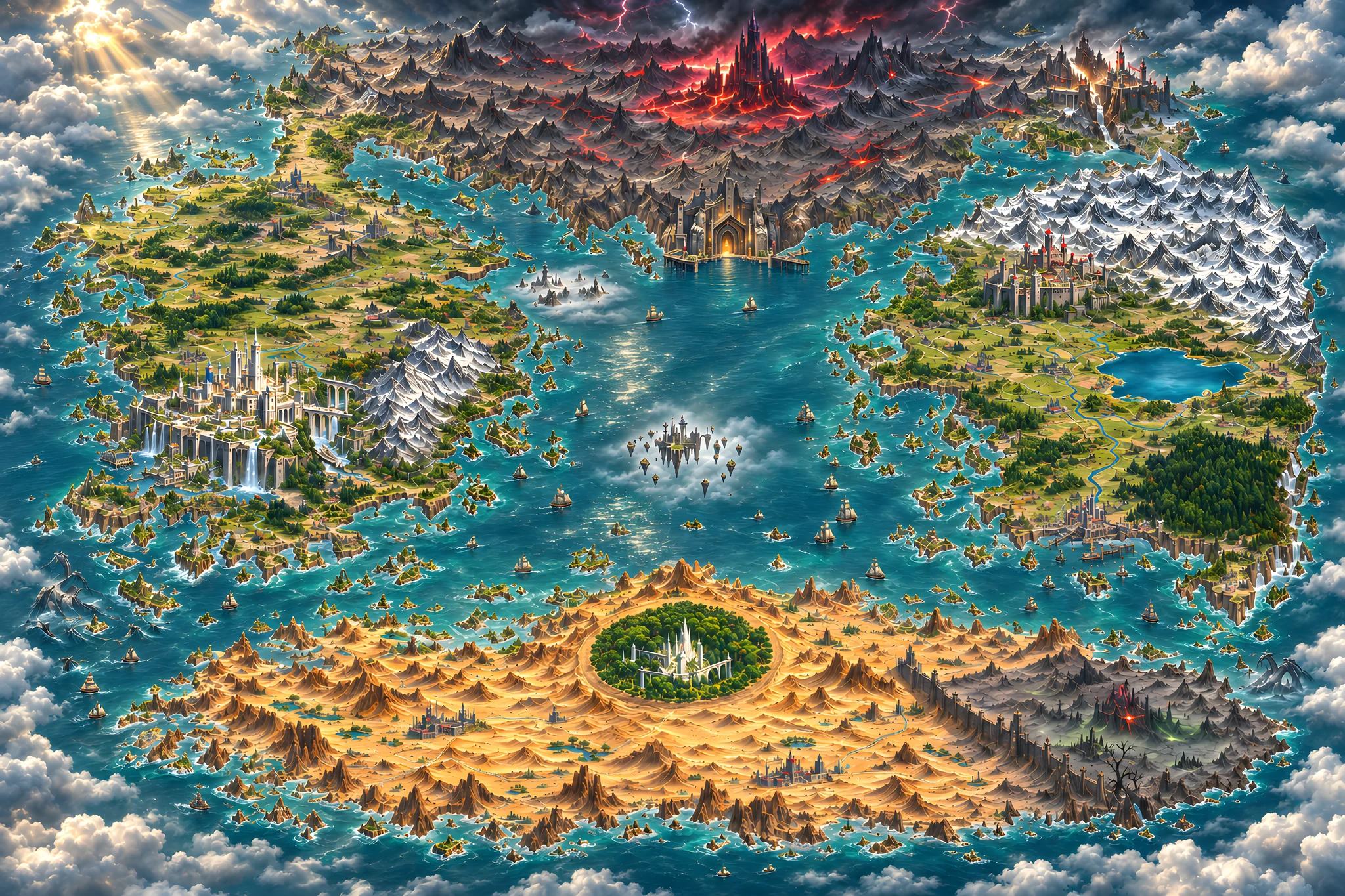
Four continents, separated by sea. Drag the map to move, scroll or pinch to zoom, and open any marker to read about the place.
Magic
The Weave is the magic of Eryndor. It runs through every living thing and through the world itself, and those who carry deep reserves of it are called the gifted.
Mages shape the Weave through a discipline, and each discipline colours the magic it makes. Most work through a focus: a staff, a blade, a book.
Old accounts speak of a place where the energy that others called magic had a different name, an older name, and moved through the body like breath rather than fire. Nobody alive seems to know what that name was.
The Adventurers' Guild
The Adventurers’ Guild runs contracts, bounties and trade protection in every guild-controlled town of Estara, Sovereth and the Sunreach. It has no reach at all in the Outlands.
Every registered adventurer carries a brooch: an emblem coated in the metal of their rank and bonded to a piece of clothing or gear. It works as a passport. Only its owner can reveal it or mask it, and a brooch registered in Tidehold is honoured in Hartland.
Everyone also knows the ranks are imperfect. They can be gamed, bought or inflated by the right connections. What counts is what you do in the field, not the metal on your chest.
Peoples
The most widespread people of Eryndor, found in every guild city from Tidehold to Hartland to the desert states. Most follow Dharani.
Near-ageless, learned and reclusive. Almost all of them live in Sylvaris, inside a forest that does not let strangers leave, so an elf on the road is a rare thing. Elves remember what the rest of the world has forgotten.
Stubborn, blunt and long-lived, and once the finest smiths in the world. Since the sealing of Karrundeep they are almost never seen on the surface.
Tall, scaled and golden-eyed. Many follow Svarog. Tidehold’s Guildmaster is one, and so is the innkeeper of the Driftwood Haven.
Horned and tailed, with skin in shades such as crimson. The first one the reader meets is a thief in Tidehold’s market.
Hardy and long-lived. Most orcs hail from the north, and they still meet suspicion in the southern cities. Many of those who came south follow Svarog.
Peoples of the northern frontier, numerous in Grokmar, the Sundered City.
Peoples who carry the shape of a beast alongside that of a man. Minotaurs are the kind most often met in the port cities: horned, bull-headed and immensely strong. Togorn picks a fight with one of them, on purpose, and regrets very little.
The peoples of the deep water, rarely seen from the surface. Sailors on the Sunfall Sea tell of sirens whose singing carries across the dead-calm patches, and few of them will say whether they have heard it themselves.
The gods
Three gods are a felt presence in Eryndor today. Their worship is common knowledge, though Book One itself names only two of them.
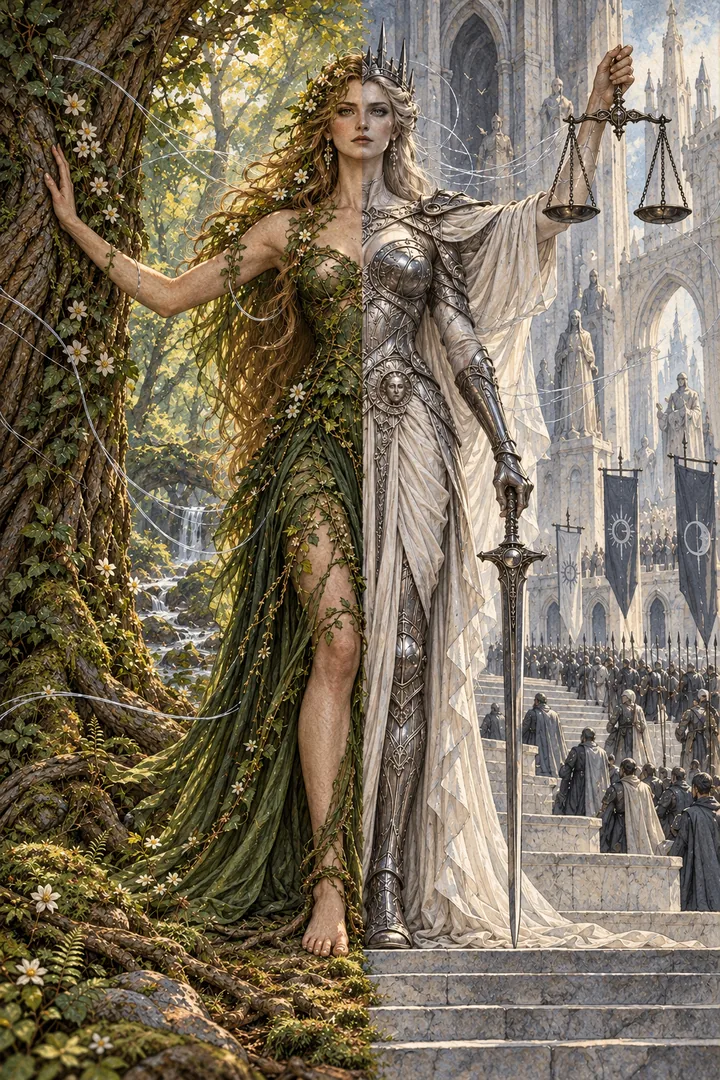
Goddess of the living world
Humans and elves
The most widely worshipped god in Eryndor, and in practice almost two religions.
The elves hold that Dharani is one with the earth: growth, the balance of living things, communion and stewardship. Humans invoke her name as the foundation of law, hierarchy and order. They have built councils under her banner, the High Council of the Weave among them, and they have conquered in her name.
It is the same goddess in two opposite spirits, and there is a quiet, ancient friction between the two peoples’ faiths. In Book One, Drace whispers her name over the last arrow he cannot afford to miss with: “Dharani, guide it.”
The Forge
Dwarves, dragonkin and many orcs
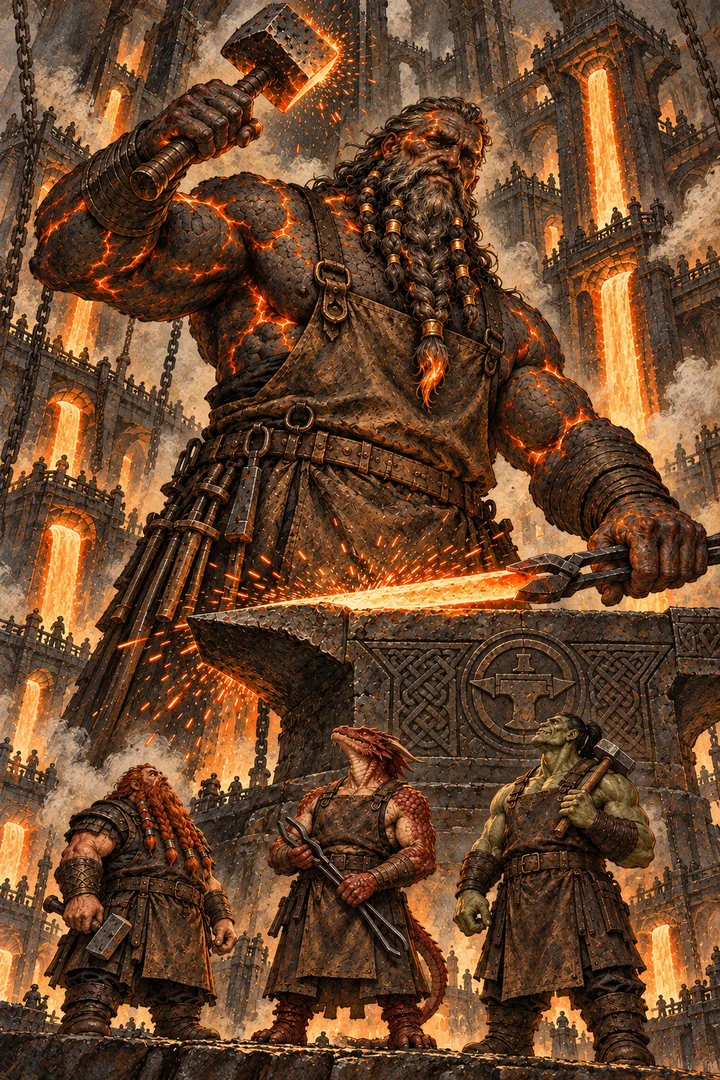
God of craft, fire, metal and making, of honest labour and the hearth.
His followers keep forge-shrines and mark their work in his name. To a smith who follows him, the forge is less a trade than a homecoming.
Togorn and Tyron swear by him, drink to him and pray to him, usually in that order. Before the leap that carries him up through the decks of the Gilded Veil, Togorn asks for one thing: “Svarog. Lend me your arm.”
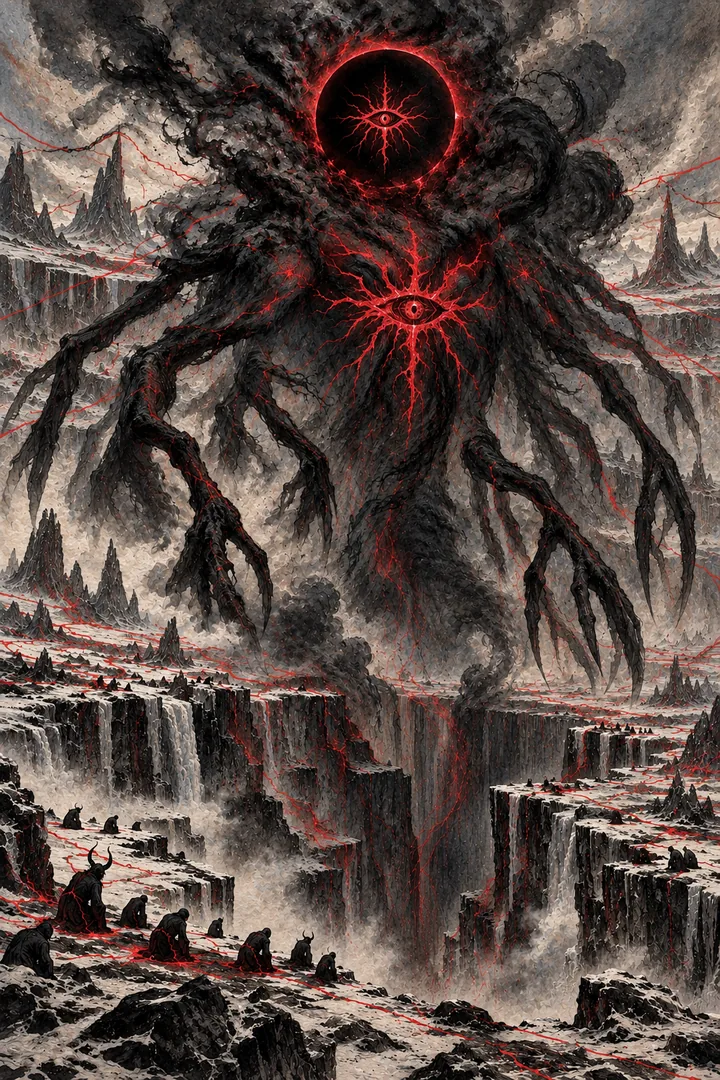
The shadow
The malevolent of every people
The dark god: lord of shadow and of a hunger that consumes everything it touches.
He is worshipped by those ruled by greed, desire and raw power. Most are demons, goblins and kobolds, but his reach now runs into every people, which is a grim measure of how far his poison has spread. Some serve him knowingly. Some never learn whose work they are doing.
He has no temples in the guild cities. His sign is an eye whose lines claw outward, and in Book One it turns up scorched into stone, inked in forbidden books, and wherever the gifted have been taken.
Spoiler warning · beyond Book One
What follows is the deep history of the pantheon. None of it is told in Threads of the Weave, and the saga reveals it slowly over the later books. Open it only if you want to know more than the characters do.
The faiths above are what Eryndor remembers. This is what it has forgotten.
Five great gods stand in the pantheon, in two tiers of age and power. The Elder Three are the oldest and by far the mightiest. Two of them are gone from the world, and almost no one alive knows they ever were.
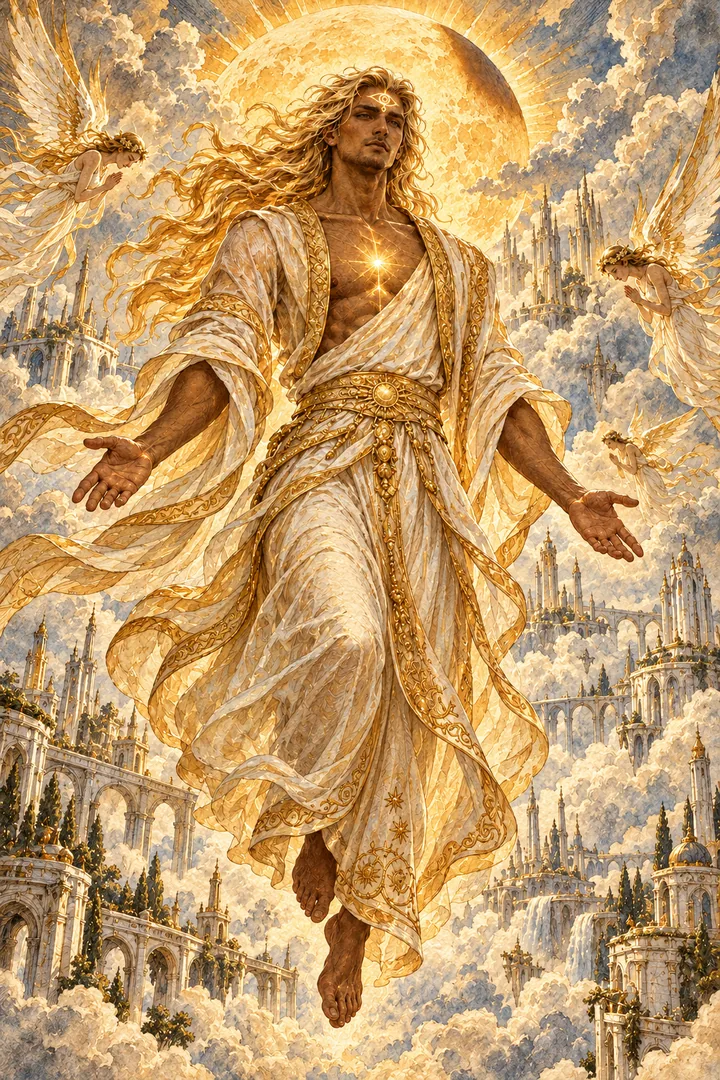
The Sun
First of the Elder Three · fallen
The first of the gods. Surya was the Sun: the bringer of warmth and energy, and the giver of a power older than the Weave, one that moved through the body like breath rather than fire.
He fell just over ten thousand years ago. His gift all but died with him, and it has not been seen in the world since.
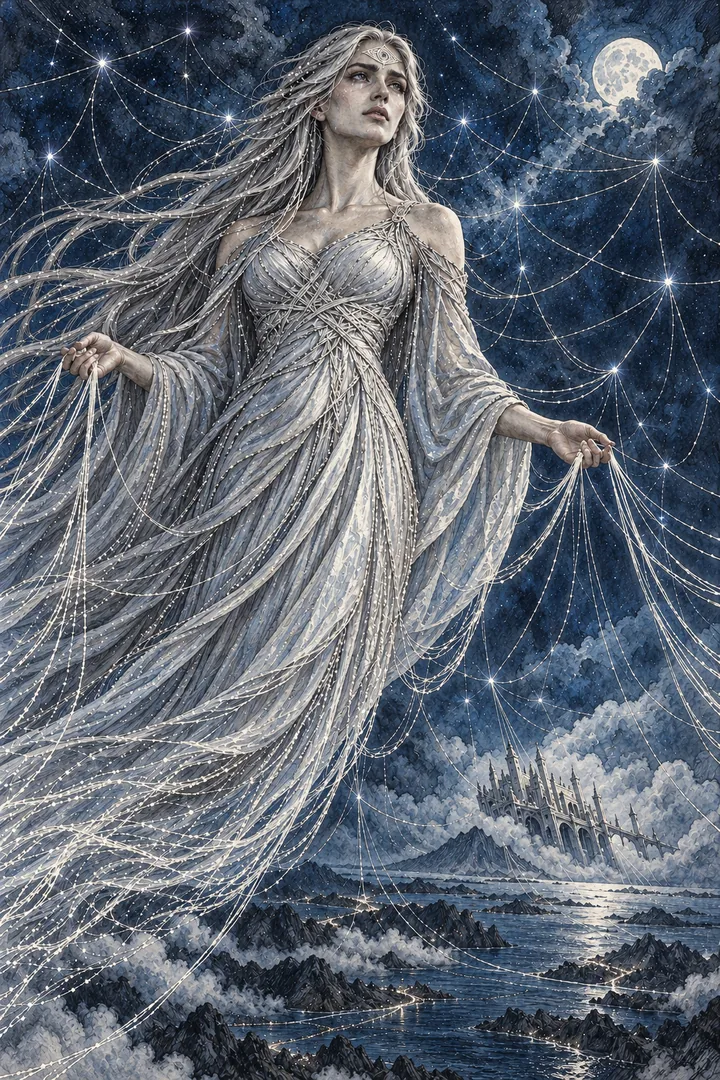
The Weave
Second of the Elder Three · departed
The second of the gods, and the one who brought the Weave into the world.
When Surya fell, Nila wept. She released all of her Weave into the world at once, then vanished to her own realm, swearing never to return. That flood is why the Weave saturates Eryndor today, and why almost all magic anyone alive has ever seen is hers.
The shadow that remained
Third of the Elder Three · the only one still here
Over uncounted ages the power of the gods seeped down into the world, and there was too much of it. In the far north the excess gathered, twisted, and congealed into something with a will of its own. Raahu rose from the wound the living now call the Riftmaw.
He once raised an army to take Eryndor outright. Surya and Nila descended and broke him. He accepted the defeat, went into hiding, and learned from it: his way ever since has been patience, whispers, and the slow turning of the world against itself.
With Surya fallen and Nila gone, Raahu is the most powerful god still active in Eryndor. The two who once checked him are no longer here to do it again.
Dharani and Svarog are the Two Younger Gods. They came to Eryndor long afterwards, drawn by the flood of unbound Weave that Nila left behind, and each made a place among the peoples who answered. They are far weaker than the Elder Three. They are also here, present and attentive, in a way the vanished elders are not.
Powers
A cross-continental institution. When a chapter is short-handed, the network sends adventurers from one city to reinforce another.
The guild authority that appoints Guildmasters. Its choice of replacement for Tidehold, sent all the way from Hartland, raises questions.
Seated in Hartland: the mages, judges and archivists who oversee magical law. Their citadel is said to hold more secrets than the rest of Eryndor combined.
The alliance of the desert city-states. Above trade, its shared purpose is to hold back the dead of Sethara.
The order that mans the Duskwall, sworn to contain what lies behind it.
One of the most feared mercenary companies in Eryndor. They fly no banner, serve no crown and answer only to coin, in amounts that could buy a city. Captain Bardock leads them.